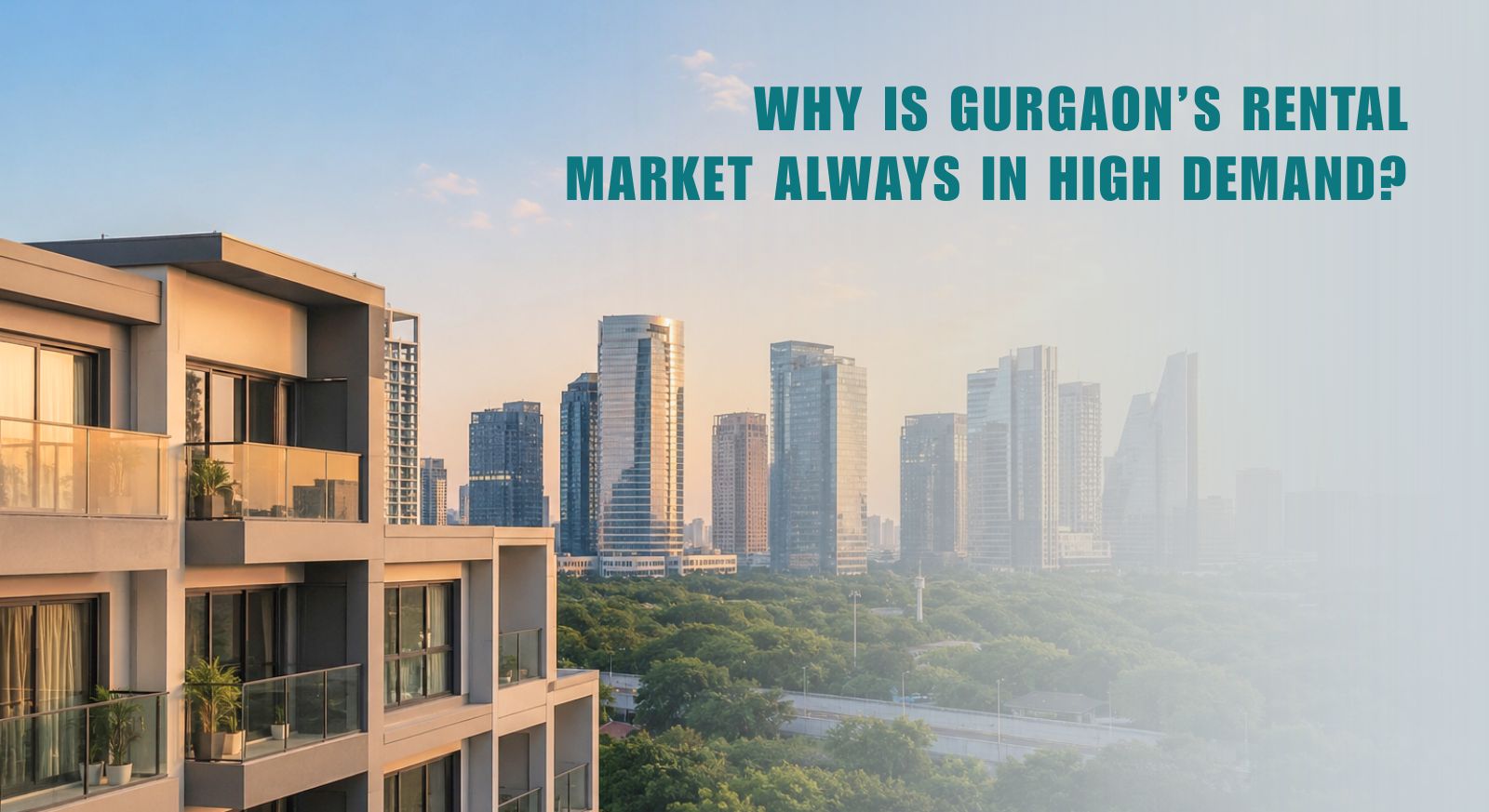
Have you ever found yourself trying to find a good place to rent in Gurgaon at the last minute? Well, if you have, then you know the routine – call multiple brokers, find several listings already gone, and discover that the remaining options are often over budget. This isn’t bad luck. It’s just how the Gurgaon rental market works, and it has worked this way for years.
It seems pretty obvious that it must just be “Gurgaon is expensive”. This is not the case, though. There are deeper reasons that need to be looked at, such as how the city was created and why very few of its inhabitants have any intention of leaving anytime soon.
Table of Contents
ToggleWhy Is Gurgaon’s Rental Demand Increasing Every Year?
Gurgaon did not grow as a traditional residential city; it evolved around its expanding corporate ecosystem. The combination of Cyber City, Golf Course Road, Udyog Vihar, and Sohna Road forms the home for more than a thousand firms, ranging from Fortune 500 firms to rapidly growing startups. Whenever a firm sets up a new office space or increases its strength in India, the first thing they need for their employees is accommodation.
This is why corporate leasing plays such a big role here. Companies routinely rent flats for their relocating staff, and this keeps demand steady through the year instead of following the usual festive-season or academic-year spikes you’d see in other cities.
The return-to-office policies enforced by the big companies during the last two years have also contributed to this problem. People who used to work from remote places but now have come to the office look for rental accommodation in Gurgaon.
How Gurgaon’s Corporate Hub Drives Rental Property Demand
Here’s something people underestimate. Gurgaon’s population is largely transient by nature. IT professionals, consultants, bankers, and startup employees move here for a role, not necessarily for life. Many are in their late twenties or early thirties, still a few years away from buying property, and simply not interested in tying up capital in a city where their job could shift them elsewhere in two or three years.
That single fact changes everything about how housing behaves here. In a city where residents plan to stay for decades, rental demand eventually plateaus. In Gurgaon, it doesn’t, because the Gurgaon rental trends and tenant base keep refreshing themselves.
Someone moves out after a promotion or a job change, and within days, someone new is looking for the same flat. Brokers will tell you vacancies rarely sit empty for long in well-connected micro-markets, even as national data shows some cooling in a few peripheral pockets.
How Metro Connectivity and Infrastructure Growth Are Expanding Gurgaon’s Rental Market
Gurgaon’s housing growth has always been closely linked to connectivity. As roads and transport networks improve, sectors that were once considered distant become more attractive to renters and buyers. Gurgaon avoided that trap.
The Dwarka Expressway, the Southern Peripheral Road, and the ongoing expansion of the Metro have silently transformed those sectors which were once dubbed “too far” into truly habitable areas. The New Gurgaon, which was once looked down upon, now boasts thousands of ready-to-move apartments with good connectivity to the central business districts.
This matters for renters because it widens choice without cooling demand. People do not seem to be pushed to remote and isolated suburbs. People find flats for rent in Gurgaon developed with commuter-friendly professionals in mind, closer to metro lines and arterial roads than ever before. Improved roadways reduce commute time by a few minutes in a sector that seemed like a different city, and that alone keeps those areas in constant demand.
How Lifestyle Preferences Are Changing Rental Flats in Gurgaon
There’s also a quieter shift happening in what tenants actually want. A decade ago, a bare two-bedroom flat with basic fittings was good enough for most renters. That’s no longer true. Today’s tenant, especially the ones working in Cyber City or Golf Course Extension, wants a gated society, a working gym, decent security, and increasingly, a fully furnished space they can move into without buying a single piece of furniture.
This development has also led to a greater need for managed and semi-managed living options. The youth in Gurgaon are seeking out convenient housing options that provide community spaces and ready-to-move-in accommodation options.
Consequently, co-living spaces in Gurgaon are becoming a recognizable part of the rental market for those who value flexibility and ease of living over rentals. Likewise, PG accommodation is also popular amongst students and young professionals.
Why Is There a Shortage of Rental-Friendly Housing Supply in Gurgaon?
One factor often overlooked is the mismatch between new housing supply and actual rental demand. New residential supply in Gurgaon has, for the past few years, leaned heavily toward the luxury and ultra-luxury segments- think ₹5 crore-plus branded residences.
Meanwhile, the mid-segment and rental-friendly ready-to-move inventory, particularly close to office clusters, hasn’t grown at the same pace. Developers naturally chase higher margins, and that’s created a visible gap between where the housing demand in Gurgaon actually needs it and where new projects are actually coming up.
The result is that ready-to-move societies near established business hubs command a real premium over under-construction ones, simply because tenants need to move in now, not eighteen months from now.
Anyone following rental trends in Gurgaon during the past couple of years must have observed how, in almost all reports on lease trends, the rise in rents in the gated societies is always higher than the rest of the market, just because of a lack of supply in this particular segment.
Conclusion: Are Gurgaon Rental Prices Expected to Keep Rising?
A temporary slowdown in a few corridors does not necessarily mean that Gurgaon’s rental market is losing momentum. Renting in Gurgaon depends mostly on the time and the location of the property. Micro-markets close to Cyber City, Golf Course Road, or the newly linked metro sectors will continue to fill up at a rapid pace, while a few peripheral areas may offer some negotiation space.
The smarter move isn’t waiting for prices to drop citywide. That’s unlikely to happen in any meaningful way given how the job market here keeps regenerating demand. It’s about knowing which pocket fits your budget and commute, and moving on it before someone else does.
The rental story of Gurgaon has very little to do with real estate when you think about it. It is a story of a city that keeps on luring more people in than it has housing to offer, and it is precisely this situation that accounts for ever-higher rent demands and disappearing flat listings within days.
Frequently Asked Questions
Is it actually cheaper to rent in New Gurgaon compared to older sectors, once you factor in commute costs?
Not always. The base rent is lower, yes, but if your office is in Cyber City or Golf Course Road, the daily cab or fuel cost from New Gurgaon can eat into a good chunk of that saving. It’s worth calculating your real monthly cost, rent plus commute, before assuming the peripheral sector is the better deal.
Why do some furnished flats in Gurgaon get rented within days while similar unfurnished units sit vacant for weeks?
The majority of people who are moving to Gurgaon in search of employment are actually migrating from other cities and do not wish to go through the tedious process of buying and selling their furniture. The idea of a furnished apartment solves all of this, and hence, they can move faster.
Does corporate leasing actually affect rents for individual tenants, or is that a separate market?
It affects everyone. When companies lease multiple flats in bulk for relocating employees, they usually pick well-located, well-maintained societies and are less price-sensitive than individual renters. This pushes up the going rate in that specific society or sector, which individual tenants then end up paying too, even if they had nothing to do with the corporate deal.