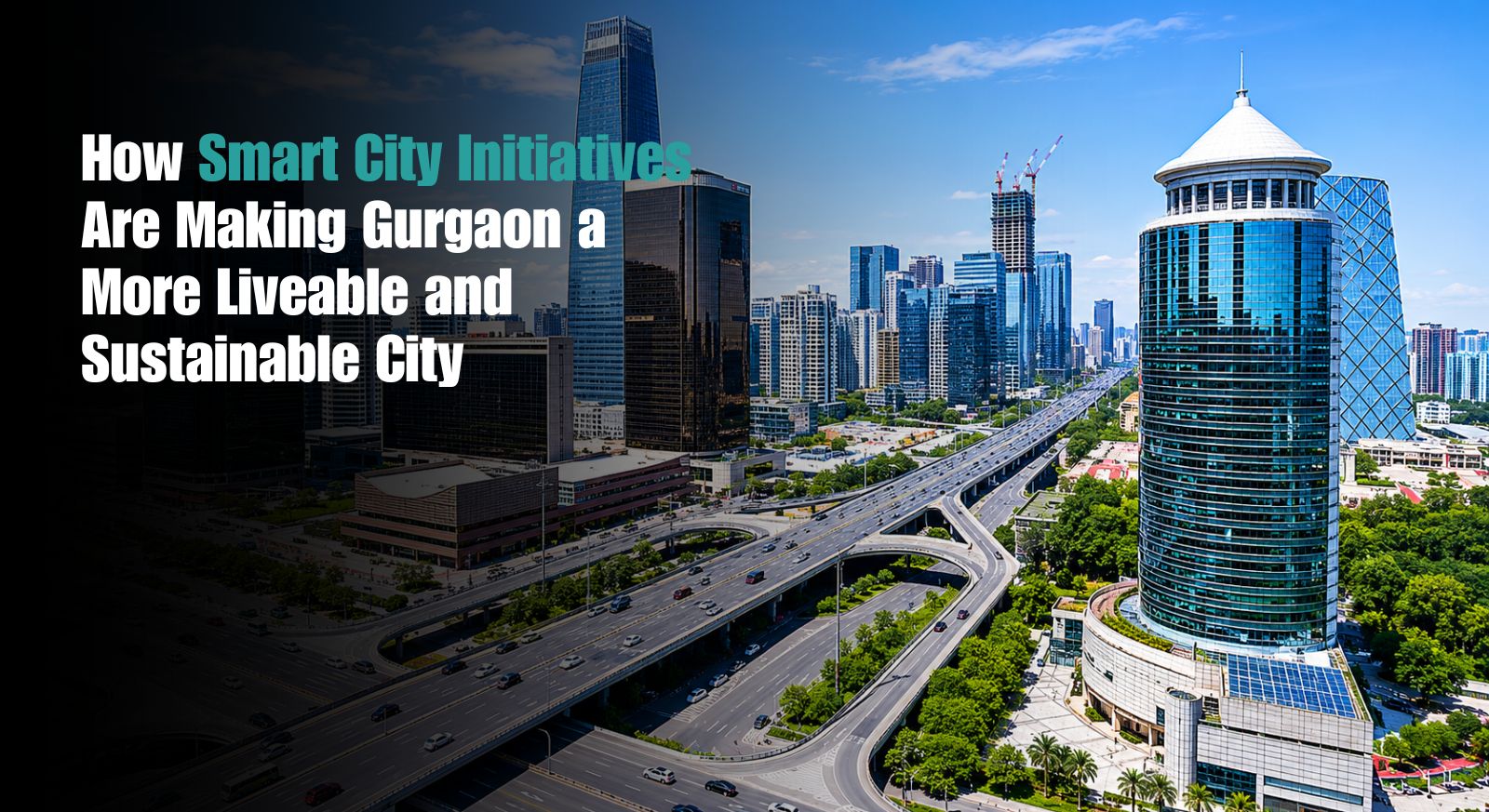
Gurgaon was once merely a small town located at the periphery of Delhi, which was primarily recognized as an agricultural area along with some housing societies. Today, it has turned out to be a city that houses over 250 of the Fortune 500 companies while also being the epicenter of India’s boldest plan for urban development.
The ambition to develop a smart city in Gurgaon has led to several initiatives in this direction on Gurgaon’s part. In fact, these efforts cover every sphere related to developing technology-based solutions to make Gurgaon truly a smart city. From traffic signals to energy-efficiency certification of buildings, everything falls under ongoing smart city initiatives.
Table of Contents
ToggleThe GMDA and the Integrated Command and Control Centre
The key organization that oversees urban development in Gurgaon is the Gurgaon Metropolitan Development Authority (GMDA). This organization came into being in 2017 and acts as the planning authority of the city for its development regarding transportation, drainage, roads, and other matters.
One of its main successes is the implementation of the Integrated Command and Control Center (ICCC) in Gurgaon. The ICCC operates under the smart city plan and deals with various things such as traffic, surveillance, air quality monitoring, and emergency services from one command system. This concept has been tested successfully in Sector 29, and plans are being laid for its application throughout the whole city.
This is definitely not just about the technology; when there is waterlogging in Gurgaon or road accidents happen at Cyber City, one can feel the difference that it can make in the response time.
Gurgaon Mobility Infrastructure: Metro, EVs & Smart Traffic Systems
Traffic continues to be the biggest bone of contention in Gurgaon, and any assessment of the city cannot do without taking this into account. However, the whole strategy has been transformed completely.
Sensors and cameras now enable dynamic signal control systems that help reduce traffic congestion. Besides the GMDA CMP, another dream of the vision of Gurgaon is to become a unified transport system comprising metro rails, e-buses, bicycle lanes, and walkways.
Construction work on the 28.5 km-long Gurugram Metro Corridor from Millennium City Centre (HUDA City Centre) to Cyber City is underway. This kind of Gurgaon infrastructure project is a silent revolution in many aspects.
Sustainable Housing and Green Building Growth in Gurgaon
One aspect that is often missed when discussing smart cities is the buildings. Green initiatives in Gurgaon are increasingly being adopted by developers and planners of Gurgaon, who have been seen in residential complexes across industries.
The concepts of rainwater harvesting, energy-efficient HVAC systems, solar power in common areas, and waste segregation are increasingly becoming popular. The process of IGBC certification, initially restricted to corporate buildings alone, is being availed of by residential housing projects as well.
The GMDA CMP also promotes non-motorised transport through cycling lanes and pedestrian-friendly zones, reducing long-term car dependency. Is enforcement always consistent? No. But the direction is clear, and developers who dismiss these standards are finding themselves at a disadvantage with informed buyers.
Buyers exploring furnished flats in Gurgaon are increasingly finding these sustainability features integrated into newer developments, where energy efficiency and responsible resource management are treated as standard specifications rather than premium add-ons.
Global City: The 1,000-Acre Blueprint
No discussion on the topic of smart cities can be complete without mentioning the project named ‘Global City,’ which is a huge township project in Haryana by the Haryana government located along the Dwarka Expressway corridor. The project is designed as an integrated ecosystem with residential zones, a finance and IT district, hospitals, educational institutions, and recreation areas.
The estimated cost of development during the initial phase will be between Rs. 940 crore. During Phase 1, the project will focus on infrastructural and commercial developments till 2026. In Phase 2, residential and institutional nodes would be established till 2029, and finally, smart transit systems along with control centers would be installed post-2030. Post-completion, the total number of people who could be accommodated would exceed two lakh.
Compared to other NCR projects, Global City stands out because it is being developed entirely on principles of sustainable urban design in Gurgaon.
Drainage and Water Management Challenges in Gurgaon’s Smart City Plan
In the discourse surrounding the smart city concept, the conversation revolves around the use of applications and transport solutions. Yet, water management and solid waste management play crucial roles in the livability factor. Drainage infrastructure has improved in other sectors, which previously suffered severe waterlogging during monsoons.
Waste management is also improving through efforts toward source segregation and better waste collection. Numerous residential societies have set up composting programs and have tied up with waste aggregators.
What Do Smart City Initiatives Mean for People Living Here?
This eventually makes its way down to decisions such as where to live and how much one must pay for these decisions. More connected areas have a higher demand, and other areas have become serious housing considerations in recent times due to their improved connectivity via metro or road connections.
The future of Gurgaon is being shaped by these layered investments. The corridors along the Dwarka Expressway and Southern Peripheral Highway, where some of the best villas of Gurgaon are located, benefit directly from the above development. Green corridors, road improvement, and proximity to Global City are coming together in one stretch.
A City Moving in the Right Direction
What sets Gurgaon apart today is its stronger institutional foundation. The presence of GMDA, a clear development roadmap, and improved coordination between agencies have brought greater focus to long-term urban planning. Over the past decade, residents have seen tangible improvements in road networks, public transport, utilities, and digital infrastructure.
What role can ICCC play for the population of Gurgaon?This has also increased the housing options available in the city, thereby making it simpler for students, professionals, and working families to get accommodation according to their requirements. For anyone who is migrating to Gurgaon in search of a job and educational opportunities, getting an appropriate PG in Gurgaon will not be difficult anymore.
Conclusion
The changes taking place in Gurgaon are not a single revolutionary process, but they are actually several linked improvements, like metro connectivity, drainage systems, and a central city management system, which together are changing the urban scene.
If taken individually, they do not carry any significance at all; however, collectively, they are bringing about a revolution in Gurgaon. In five years, for sure, there will be a different Gurgaon because of the efforts being made towards this goal.
FAQs
What role can ICCC play for the population of Gurgaon?
The amalgamation of traffic, CCTV cameras, AQI, and emergency services on the same platform proves very useful in addressing flood, traffic accident, and traffic management issues.
How do IGBC-certified houses benefit residents?
An IGBC-certified house complies with energy and water-saving and high-quality indoor air guidelines. This helps people save costs and live in healthy conditions.
What is unique about the Global City Project compared to others?
While other NCR projects are generally run by developers, the Global City Project is the brainchild of the government and follows strict criteria for smart cities.