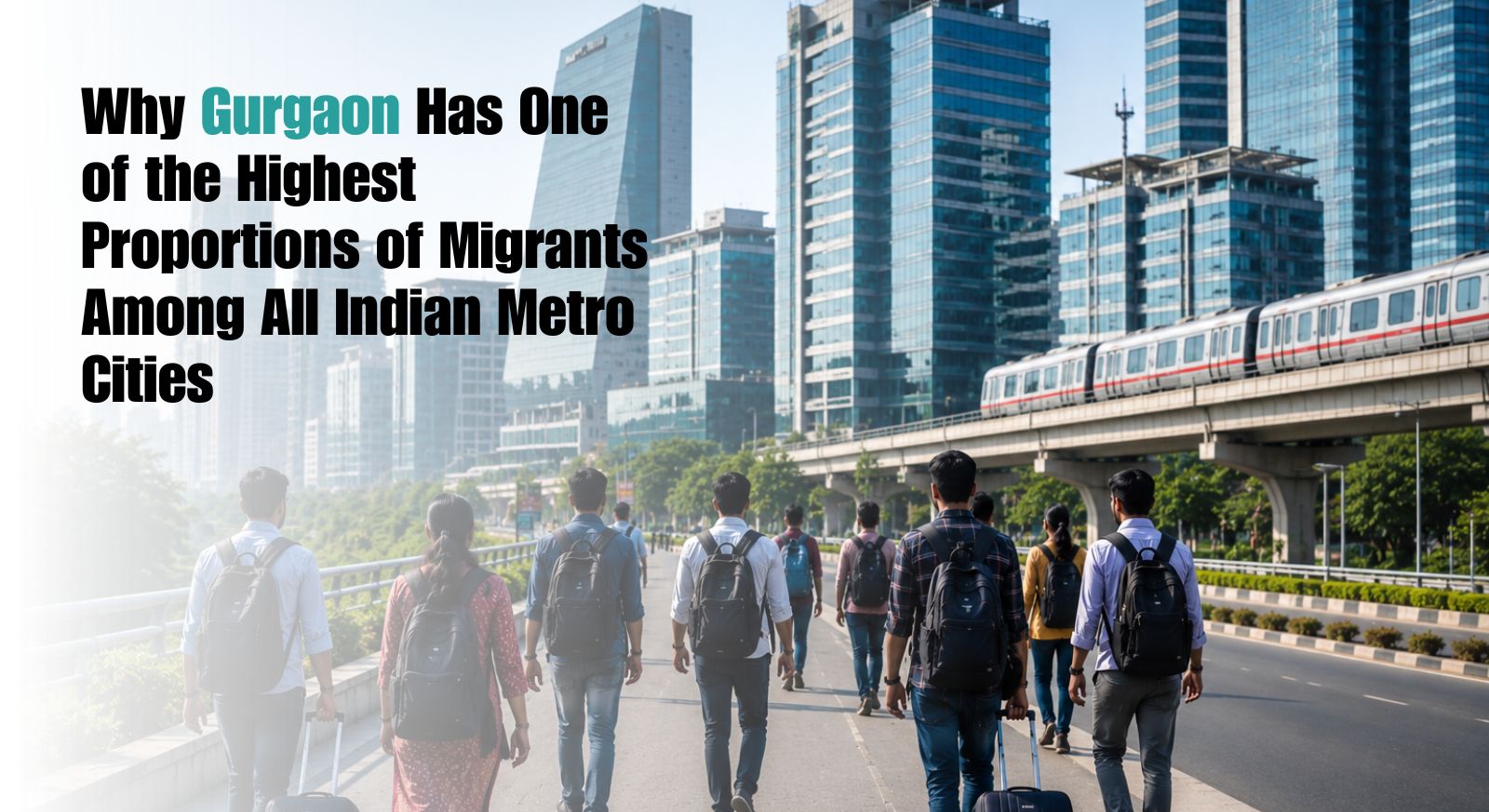
Gurgaon has something quietly distinctive about it. Gurgaon’s population has grown to almost 2 million, with most residents coming from elsewhere. This change tells you more about Gurgaon than seeing its fancy skyline or corporate parks. Gurgaon’s migrant population turned the city into one of India’s fastest-growing urban areas. So, what makes Gurgaon different from other cities like Pune, Hyderabad, or Noida? Why does it have the highest proportion of migrants among all Indian metro cities? Let us understand the exact reasons below.
Table of Contents
ToggleA city assembled almost overnight
Gurgaon didn’t develop as typical cities do. The place transformed rapidly after India opened up economically in the early ’90s. When the nation swung open its doors to global trade, big international firms were on the lookout for spots near Delhi to run their show. Due to its handy location close to both the capital and the airport, Gurgaon drew interest quickly.
Genpact was among the first to jump in, setting up camp there in the mid-’90s as a GE division. After that, others joined the rush. By the start of the 2000s, DLF Cyber City blossomed into a major business hotspot, drawing giants like Samsung, Dell, Accenture, and Wipro.
As those companies grew, they ramped up job openings. Large numbers of people from across India came to Gurgaon for employment, prospects, support crew, and labourers alike. The city’s expansion was about more than buildings; it was about all these people flooding in to start new jobs.
The impact was remarkable. Gurgaon’s population grew by nearly 283% between 2001 and 2011, largely driven by migrants seeking better jobs and living standards. This influx helped turn it into one of India’s fastest-growing cities.
Who actually moves here, and why
People arrive from nearly every corner of India, and the diversity of that inflow is genuine, not just a talking point. The largest groups come from Uttar Pradesh, Bihar, Rajasthan, and Punjab. But the reasons they come differ sharply depending on background and circumstance.
Construction workers and daily wage labourers arrived early, drawn by Gurgaon’s booming real estate market. They worked in garment factories and industrial areas like Udyog Vihar, so there were lots of jobs. These were not people chasing uncertain opportunities; they were following a job market that had no equivalent back home.
Alongside them came a very different wave: young professionals in IT, finance, consulting, and healthcare. With the third-highest per capita income in India and the most high-paying corporate jobs in all of North India, Gurgaon is more than just a city. To young engineers coming from places like Lucknow or Patna, it’s their next big opportunity.
Although migrants come from different parts of the country, they are often driven by the same goal: finding better opportunities. Gurgaon continues to attract people with its career growth potential and higher earning prospects.
Why is the employment pull unlike anywhere else in North India?
What drives people here is straightforward – the jobs are here and nowhere else in similar quantity or quality. A software engineer from Jaipur who offered a position in Cyber City would rarely find an equivalent locally. They move with little pause because the salary, network, and career paths are all in Gurgaon.
Gurgaon’s employment opportunities are quite distinct from cities like Mumbai or Kolkata. Those places developed over generations, and their local workforces can partly handle the demand, but Gurgaon is different. Gurgaon’s entire economic identity was created within roughly two decades. It never had a large, stable local labour pool to begin with. The jobs came first, and people followed from everywhere.
That rapid transformation explains why Gurgaon became India’s corporate capital in just 20 years. The once tranquil suburban area transformed itself into one of the busiest economic centers of India, pulling in multinationals, entrepreneurs, and professionals like never before. Very few other urban centers in India have seen as much economic activity concentrated in so short a time span, and the labor force of this city owes its formation to this incredible growth spurt.
Why have other cities not seen this at the same scale?
Cities like Jaipur or Chandigarh have grown steadily, but their job markets have developed alongside local populations. Gurgaon moved differently. The others don’t have that central business hub like DLF Cyber City or Udyog Vihar in Gurgaon. Office spaces are scattered around, and they have generally kept up with local job needs.
In Gurgaon, though, the story changes. It grew super fast, and its local worker supply couldn’t keep up. This gap is filled with people moving in from elsewhere. Since Gurgaon keeps expanding along the Dwarka Expressway and Southern Peripheral Road, it constantly needs more workers.
Being part of the Delhi NCR amplifies all of this considerably. As a key metro city in the region with direct Metro connectivity to central Delhi, it offers professionals access to the broader NCR economy, making it an attractive base even for those whose work takes them across multiple locations throughout the week.
How Migration Shapes Gurgaon’s Housing Market
One of the clearest signs that migration shapes this city at a foundational level is the rental market. Unlike in many other Indian cities, where owning a home is the norm, lots of Gurgaon residents rent. Since it’s full of migrants who think they’ll move on within a few years, buying a place doesn’t make sense to them.
This keeps demand for flexible housing consistently high across the income spectrum. At the top end, senior execs relocating with families and successful entrepreneurs choose spacious, private properties. They want more than just homes; they seek estates that feel permanent. This strong demand for luxury villas in Gurgaon shows that these migrants no longer see themselves as newcomers. They have made Gurgaon their home. They stayed, built careers, and built lives.
Conclusion: Gurgaon’s Growth Story Is Driven by Migrants
Most people moving to Gurgaon are between 20 and 40, typically driven by job opportunities, not planning to settle permanently. This explains why the city is always evolving. What began with a bunch of offices and building sites transformed over time into actual neighborhoods, rental markets, and whole communities.
After all, the folks who came for work were the ones shaping these spaces. Migrants really built Gurgaon. As people moved in from all over India seeking better prospects, new areas popped up along with shops and social groups. They initially intended to stay temporarily, but many ended up establishing homes, significantly changing the city’s face.
FAQs
Which states do migrants mostly come from in Gurgaon?
Most migrants come from Uttar Pradesh, Bihar, Rajasthan, and Punjab. There is also a noticeable flow from southern states, mainly driven by IT and corporate job opportunities. Together, these groups create a very mixed population base.
Does migration to Gurgaon include only professionals?
No. It includes both skilled and unskilled workers. Along with corporate and IT professionals, many blue-collar workers come for jobs in construction, housekeeping, security, delivery, and retail. Both groups keep the city running.
Why do most migrants in Gurgaon rent instead of buy?
Most migrants treat Gurgaon as a work-based, flexible stay. Since jobs can change and property is expensive, renting is easier and less risky. It also lets people move quickly when work or location changes.