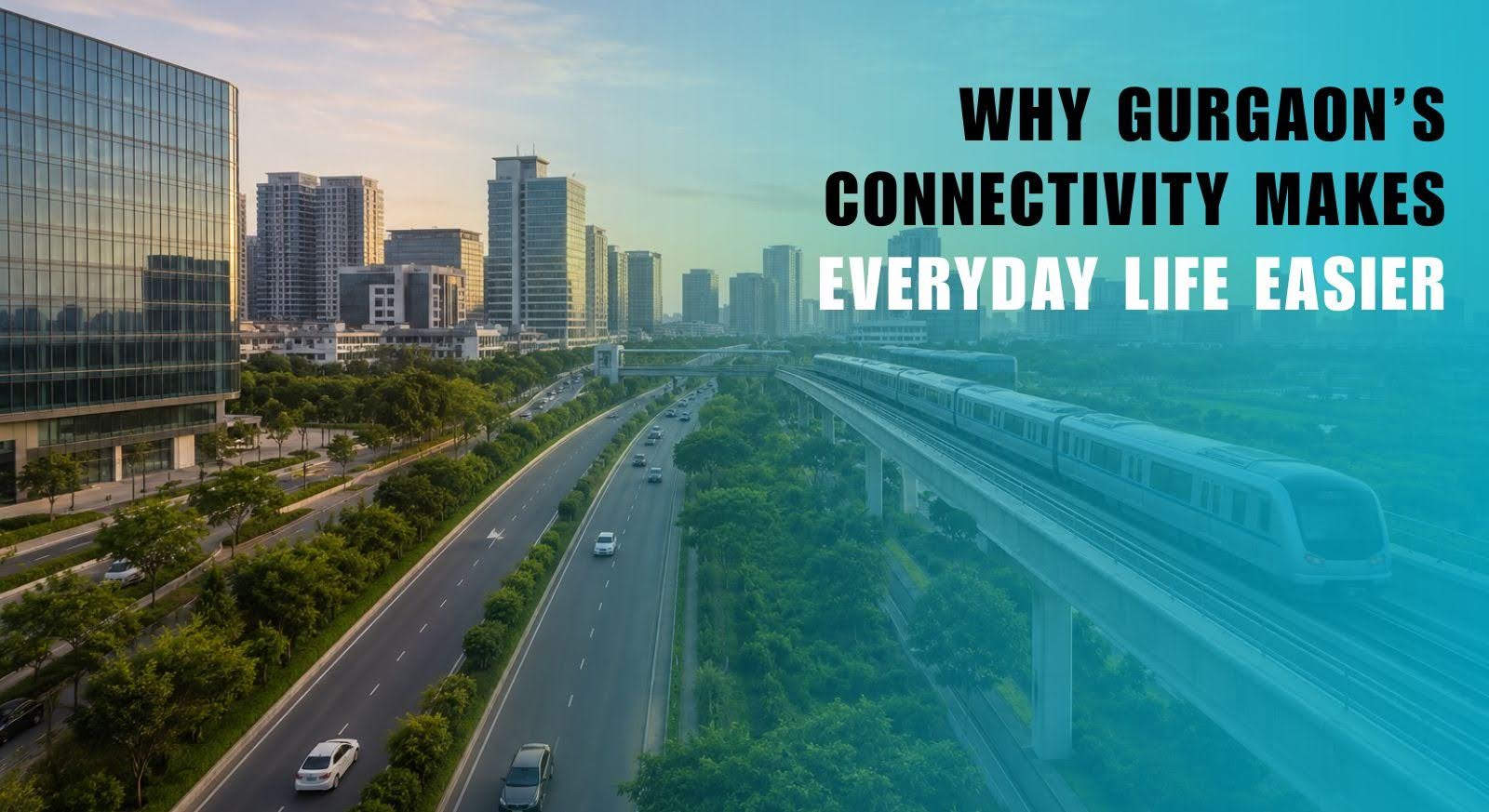
There’s something satisfying about a city that makes everyday life easier. You know how long your commute will take, and whether you travel by road or metro, getting around is usually predictable. Anyone who happens to be either residing in or considering a relocation to the NCR will realize that Gurgaon’s connectivity makes a convincing case for Gurgaon as a choice of city.
This is no surprise either. It is not just about a couple of flyovers and a railway station. As years went by, Gurgaon established an effective transportation system comprising roads, metros, and airports for its residents’ ease.
Table of Contents
ToggleMetro Connectivity in Gurgaon Makes Daily Commuting Simple
Let’s begin at the metro, as here people start their commute. Two metro systems serve the city – the Delhi Metro Yellow Line that starts at Samaypur Badli in North Delhi and ends at Millennium City Centre, and the Rapid Metro whose route begins at Sikanderpur and goes to DLF Cyber City, Golf Course Road, and Sectors 55-56.
Delhi Metro Yellow Line and Rapid Metro Network
The fares in the Yellow Line depend on the distances traveled, and they range from Rs. 10 to around Rs. 60. The Rapid Metro runs at an expense of around Rs. 25 to 40. They both operate from around 5:30 AM to 11:20/11:50 PM.
The switching is possible between the two lines via Sikanderpur Station. You have to board the train on the Yellow Line in Delhi, change at Sikanderpur, and reach Cyber City by avoiding a taxi.
Upcoming Gurgaon Metro Expansion
A new 15.3 km metro corridor from Millennium City Centre to Basai (Phase 1), with a spur to the Dwarka Expressway, is currently under construction. The entire scheme will extend up to 28.5 km in the future and will finally provide metro connectivity to Old Gurgaon, which has remained without it to date. The estimated ridership capacity for the entire corridor is 5.34 lakh passengers per day when the corridor becomes fully operational.
Road Infrastructure in Gurgaon Supports Faster Travel
Not everyone relies on the metro, and the Gurgaon transport network takes care of the others pretty efficiently.
NH-48: The Main Street of the Delhi-Gurgaon commute
NH-48 is the Delhi-Gurgaon Expressway. It constitutes the main road of Gurgaon. The total length of this expressway is 27.7 kilometers, and it has eight lanes in Delhi and six lanes in Haryana. There are eleven flyovers and eleven underpasses on this expressway. It takes thirty to forty-five minutes on average. But problems with traffic occur at IFFCO Chowk and Kherki Daula Toll Plaza.
Impact of Dwarka Expressway on Gurgaon connectivity
The Dwarka Expressway is a great help to the people living in New Gurgaon. The Dwarka Expressway is an expressway of length 29 km connecting Sectors 105-115 and South West Delhi & Mahipalpur. For anyone in New Gurgaon, this road has practically redrawn how daily distances are calculated.
Southern Peripheral Road and Internal City Connectivity
Internal movement depends on the Southern Peripheral Road and the Central Peripheral Road. While these roads may not attract much attention, they significantly improve intra-city travel. It is the road infrastructure in Gurgaon that differentiates life in this city from those other cities that have expanded beyond the development of their roads.
Airport Connectivity Makes Gurgaon Ideal for Business Travellers
IGI Airport sits roughly 15–20 km from most of Gurgaon. On a clear run via NH-48 through Mahipalpur, it is a 20–30-minute drive. Even with moderate traffic, most residents can plan an airport transfer in under 45 minutes.
For frequent flyers, this matters more than any other infrastructure factor. Fast access to the airport helps frequent travelers, especially when leaving the place early in the morning. Taxi apps like Ola & Uber function 24/7, and it costs us between Rs 500 and Rs 1,200 to be driven to the airport by them.
Metro Route to IGI Airport from Gurgaon
For those who would rather skip surge pricing, there is a metro option. Yellow Line to New Delhi Station, then take the Airport Express train to Terminal 3, which takes about 60–75 minutes from Millennium City Centre. Takes some time, but quite reliable and predictable, which is often more important.
Travel Convenience in Gurgaon for Everyday Mobility
Good travel convenience in Gurgaon is not just about the entry and exit points. It is also about whether moving around inside the city is workable on a daily basis.
Last-Mile Connectivity Across Gurgaon
Auto rickshaws, e-rickshaws, and bikes offer coverage for the last mile from almost all metro stations. Areas along the roads, such as Golf Course Road, Sohna Road, and MG Road, have the maximum layers as far as proximity to metro stations, connectivity, and presence of cab services go.
Transit Connectivity and Housing Demand in Gurgaon
The Delhi-Gurgaon commute also looks different depending on the mode. By metro, it is predictable. By road, it is variable but manageable outside peak windows. Most working professionals in the city develop a feel for which combination works on which days, and the fact that there are multiple real options is the point.
For those relocating for work, particularly professionals moving from other cities, transit access tends to be one of the first things that shape the shortlist. Sectors with strong metro connectivity fill up faster. Areas with strong metro connectivity tend to see higher rental demand because they make daily commuting more convenient.
As a result, PGs and co-living spaces in Gurgaon near Rapid Metro stations are usually the preferred choice for those looking for flexible, short-term accommodation. For professionals planning to stay longer, renting a furnished flat in a well-connected sector offers greater comfort while keeping commute times manageable.
Why Gurgaon Connectivity Continues to Attract Professionals
Good Metro connectivity in Gurgaon, along with road connectivity and airport connectivity, makes Gurgaon one of the best places to be for any professional in the NCR area. Being in proximity to the IGI Airport makes commuting and travel much easier and faster. This aspect largely determines the decision to move.
Gurgaon has one of the highest proportions of migrants among Indian metro cities, driven by its concentration of corporate offices, startups, and service sector jobs. Many residents have moved from other states for work, and this mix of opportunity and access continues to define the city’s growth. It creates an evident cycle whereby higher connectivity leads to more professionals, and more professionals create increased demand for infrastructure and housing.
FAQs
How does the metro connectivity impact housing options in Gurgaon?
Properties closer to metro stations usually appeal to the professional working community, as these places save time and offer connectivity to important business areas. It increases the demand for PG, co-living, or rented apartments in such locations.
Where can one find places that have proper connectivity in terms of metro in Gurgaon?
Metro connectivity, to some extent, is there in certain places such as Cyber City, MG Road, Golf Course Road, DLF Phase 2 & 3, and certain Rapid Metro-connected sectors.
What all needs to be kept in mind while opting for proper housing based on connectivity in Gurgaon?
You need to opt for those homes which are near metro stations, NH-48, and Golf Course Road, have facilities for last-mile transport, and consider how much time it takes to reach your office.
How has Dwarka Expressway helped in improving connectivity in Gurgaon?
Dwarka Expressway has provided better connectivity to New Gurgaon, Delhi, and the Airport, thereby reducing reliance on NH-48.